
Open Source Intelligence Curriculum Development for Higher Education in Japan
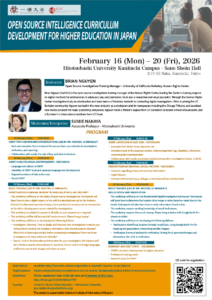
Open Source Intelligence (OSINT) has become an essential tool in international relations for verifying military actions, human rights violations, and information manipulation by analyzing social media, publicly available data, satellite imagery, and geographic information systems. In partnership with the Human Rights Center at the University of California, Berkeley School of Law, a leader in integrating OSINT into university education, this program aims to develop an OSINT curriculum for Japan based on discussions about the current state and needs of OSINT in East Asia, including Japan, along with a mock training exercise. This training will consult the Berkeley Protocol on Digital Open Source Investigations, which is currently translated into Japanese.
Date: February 16 (Mon) – 20 (Fri), 2026
Location: Hitotsubashi University Kunitachi Campus
Sano Shoin (2-17-35 Naka, Kunitachi, Tokyo)
Participants: Faculty and practitioners are welcome to join per session. Student participation will be for mock training only.
Language: English and Japanese consecutive interpretation provided
| 16 February (Mon) | |
| 10:00-12:00 | OSINT for human rights investigations (led by eMr. Nguyen, UC Berkeley)
• Real case examples: the overview of the process from case selection to investigation, verification, and reporting • Collaboration with media, the rule of law, and other institutions |
| 14:00-16:00 | OSINT in multilingual environments – discussion
• Language and culture in OSINT • Versatility of OSINT tools and Japanese-language tool development • Regional variations of data and access • AI and OSINT |
| 17 February (Tue) | |
| 10:00-12:00 | OSINT landscape in East Asia – discussion
• Examples from North Korea, Myanmar, etc. • Domestic needs in the Japanese context: crisis management (e.g., disasters), cybercrime, countering fake/misinformation • Collaboration with media and private entities (independent investigative bodies, CivTech, etc.) |
| 14:00-16:00 | Understanding Regional Social Factors – discussion
• Concerns regarding privacy and personal information • Digital literacy • Normative frameworks (e.g., linkages to international law and standards) |
| 18 February (Wed) | |
| 10:00-16:00 | Mock training (led by Mr. Nguyen, UC Berkeley)
Investigation planning, search techniques, ethics, and security · This workshop will focus on the basics of open source investigations. Participants will learn how to plan a digital inquiry in line with the standards set out by the Berkeley Protocol, fundamental search techniques, best practices for security, and an introduction to the ethics of using open-source material for investigations. · This workshop is suitable for people of all skills; no prior experience is required. · This workshop will be half lecture, half hands-on work. Please bring a laptop! · This workshop will focus on developing the following skillsets: o Investigation planning – how to design and structure your investigation to ensure you will be able to develop the necessary information. How should cases be selected? What kind of planning is needed before conducting investigations? How can these investigations be done safely and ethically? o Search – how to find the relevant information for your investigation. Participants will learn Boolean search, advanced search operators, how to search in foreign languages, and how to search with images and videos as input. |
| 19 February (Thu) | |
| 10:00-16:00 | Mock training (led by Mr. Nguyen, UC Berkeley)
Geolocation and verification · This workshop will focus on two fundamental digital investigative techniques. Participants will learn how to determine the location of an image or video based on visual clues in the media. Participants will also learn how to verify information found online. · This workshop requires working knowledge of search techniques. · This workshop requires the use of a laptop. Please bring a device with Google Earth Pro already installed. · This workshop will focus on developing the following skillsets: v Geolocation o Identifying locations through visual clues. o Using Google Earth Pro for mapping and geolocation. o Interpreting satellite imagery v Verification o Forms of analysis for verification. o Testing for AI-generated images and information. o Use of AI in verification |
| 20 February (Fri) | |
| 10:00-15:00 | Summary and next steps – discussion
· OSINT curriculum development for higher education · Professional training needs · Research areas for OSINT |
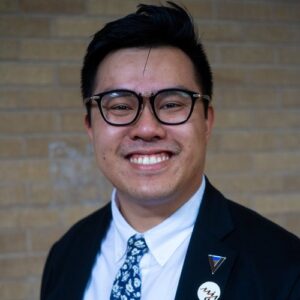
Instructor: Brian Nguyen
Open Source Investigations Training Manager – University of California Berkeley, Human Rights Center
Brian Nguyen (he/him) is the open source investigations training manager at the Human Rights Center, leading the Center’s training program on digital methods for professionals in advocacy, law, and journalism. He is also a researcher and visual journalist. Through the Human Rights Center Investigations Lab, he also teaches and leads teams of Berkeley students in conducting digital investigations. Prior to joining the UC Berkeley community, Nguyen worked in the news industry as a photojournalist for newspapers including the Chicago Tribune, and launched new media products for major publishing companies. Nguyen holds a Master’s degree from UC Berkeley’s Graduate School of Journalism, and a Bachelor’s in international relations from UC Davis.
Moderator/Interpreter: Sumie Nakaya, Associate Professor
Hitotsubashi University
Registration: February 13th (Fri) noon, via link below.
https://forms.gle/DnZJR51tMX4i5rYN7
Contact: Center for Global Online Education – Hitotsubashi University
goe-center-jimu@arinori.hit-u.ac.jp